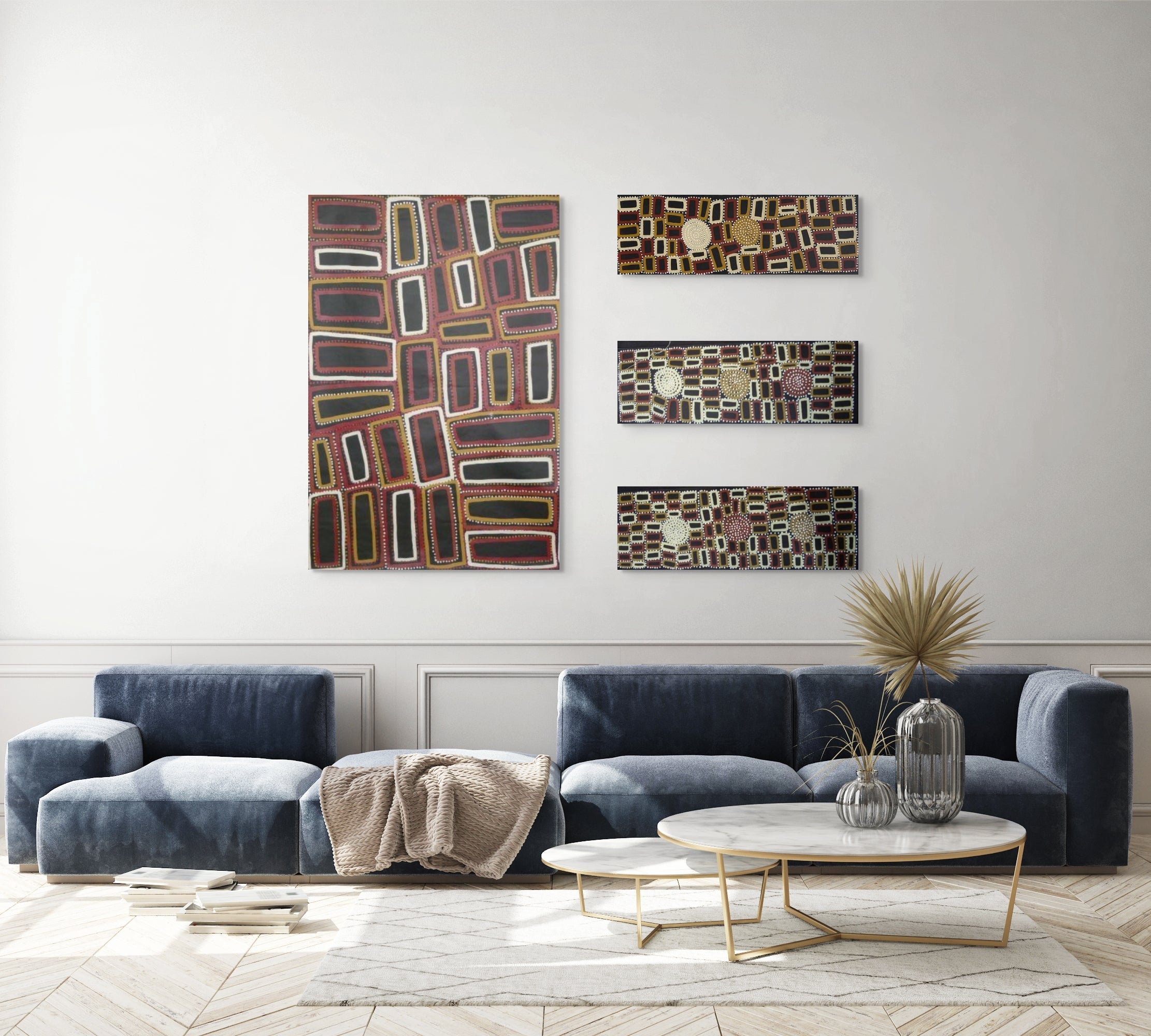
At first glance, many Central Desert paintings appear rhythmic and abstract. Dots pulse across the surface. Lines intersect. Colour fields stretch outward in quiet intensity.
But nothing is random.
Every mark sits within a system of responsibility. Every composition emerges from kinship, Country, and inherited authority. To understand aboriginal art is to understand relationship.
Without that context, a painting risks being reduced to surface beauty. With context, it becomes cultural testimony.
Kinship as Cultural Framework
In many Central Desert communities, kinship systems structure life. They determine marriage relationships, ceremonial roles, and rights to speak for particular ancestral narratives. These systems are not symbolic. They are social law.
An artist does not choose subject matter freely. They paint stories that belong to their lineage. Authority is passed down through family connections and ceremonial initiation. This ensures that cultural knowledge remains protected and correctly represented.
When collectors engage with this reality, appreciation deepens. A painting becomes more than an object. It becomes an expression of belonging.
Kinship determines who may depict certain sites, who may reference specific ancestral journeys, and how stories may be shared publicly. Some aspects are open. Others remain private. Ethical representation respects those boundaries.
Understanding this structure is not academic. It directly influences collecting confidence.
Cultural Knowledge Embedded in Form
Symbols within Central Desert painting often reference waterholes, sandhills, ceremonial grounds, or ancestral pathways. Repetition may represent ritual rhythm. Concentric circles can signify gathering places. Flowing lines may trace movement across land.
Yet these visual elements are layered. Some knowledge is shared openly through gallery interpretation. Other layers remain within community.
That balance protects cultural integrity.
For collectors exploring aboriginal art for sale, this distinction matters. Authentic works carry both visible and protected knowledge. They are grounded in lived tradition rather than decorative invention.
The deeper a collector understands this visual language, the stronger their connection to the work becomes.
Context Increases Meaning and Value
Serious collectors do not stop at aesthetics. They ask: Who is the artist? What is their Country? What kinship group do they belong to? What stories are they authorised to paint?
These questions are not intrusive. They are essential.
An informed gallery provides detailed artist biographies, community background where relevant, and provenance documentation. This information strengthens authenticity and supports long term cultural value.
When context is clear, acquisition becomes intentional rather than impulsive.
The Indigenous art market has matured significantly over the past decades. Collectors now seek works with strong documentation and cultural grounding. Paintings with clear lineage and verified origin, whether from an art centre, an independent artist, or a reputable dealer, consistently hold greater historical and market significance.
Understanding kinship and cultural knowledge is therefore not only respectful. It is wise.
Intergenerational Continuity
One of the most compelling aspects of Central Desert painting is visible continuity between generations. A mother's brushwork may echo in her daughter's style. A grandfather's compositional structure may reappear in a nephew's work.
Yet each artist brings personal nuance within cultural boundaries. And for artists who work independently, outside the art centre model, that continuity is expressed through their own practice, maintained on their own terms.
This layered continuity strengthens both cultural endurance and collector confidence. When a practice is sustained across generations in whatever form it takes, it demonstrates resilience. That resilience underpins artistic significance.
Collectors who invest time in learning about artist families and individual careers often discover deeper connections across works in their collection. Patterns emerge. Stories interweave. Relationships become visible.
This level of engagement transforms collecting into stewardship.
Why Ethical Representation Matters
An ethical aboriginal art gallery does more than display paintings beautifully. It ensures that cultural information is accurate. It verifies artist authorship. It maintains respectful relationships with artists across all channels, including those who represent their own work.
This transparency protects both artist and collector.
In a market where imitation and misattribution have historically occurred, clear provenance safeguards integrity. It allows collectors to move forward with confidence, knowing the work is grounded in rightful authority.
Red Desert Dreamings works with artists, independent dealers, and community art centres to ensure documentation is thorough and culturally respectful. Stories are shared appropriately. Boundaries are honoured. The full range of how Indigenous artists bring their work to market is embraced rather than narrowed.
For serious collectors, that framework is invaluable.
Beyond Decoration
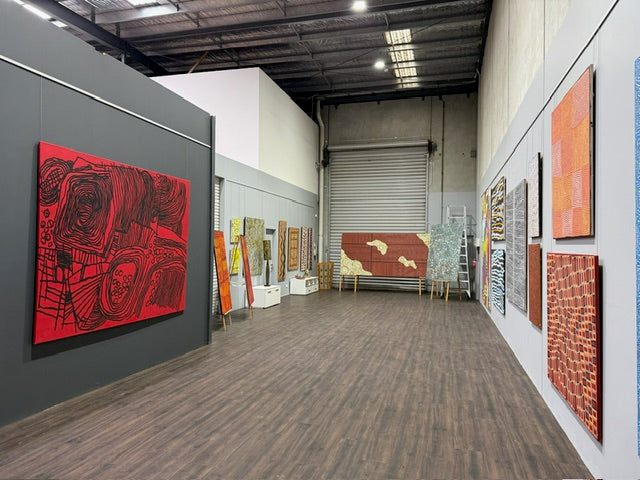
It is easy to admire colour and movement. Central Desert works possess remarkable visual power. Large scale compositions can command a room. Fine dotted surfaces invite close contemplation.
But decoration alone does not sustain cultural practice. Cultural knowledge embedded within the work is what gives it endurance. It is what connects present to past. It is what ensures that each painting participates in a living continuum.
When collectors understand this, acquisition becomes more meaningful.
The Collector's Responsibility
Collecting Indigenous Australian painting carries responsibility. It requires willingness to learn. It requires respect for cultural law. It requires partnership with ethical representatives.
That responsibility also brings reward. Collectors who engage deeply often find their appreciation expanding beyond individual works. They begin to understand regional variations. They recognise stylistic shifts across decades. They identify familial connections between artists and trace the careers of those who have forged their own independent paths.
Their collection evolves with intention rather than impulse.
Experience the Stories Firsthand
While written interpretation offers insight, nothing replaces direct engagement. We encourage collectors to book a free tour and spend time with works in person. During private viewings, we explore artist biographies, kinship context, and the cultural frameworks that shape each painting.
Questions are welcomed. Conversations are unhurried. Understanding the stories within transforms the way you see the surface.
A Living Cultural Practice
Indigenous art from the Central Desert is not static heritage. It is an active cultural practice sustained through ceremony, teaching, and community strength, and through the determination of individual artists who carry tradition forward in their own way.
Each painting is a continuation of that practice.
When collectors approach these works with knowledge and respect, they participate in a broader cultural relationship. They help sustain artists. They support communities. They honour ancestral narratives.
And in doing so, they discover that the true value of a painting lies not only in what is visible, but in what it carries forward.
If you are considering acquiring a work grounded in kinship and cultural authority, we invite you to visit us. Spend time with the paintings. Ask about lineage. Explore provenance.
Because once you understand the stories within, you will never see the surface the same way again.
Frequently Asked Questions
What do kinship systems have to do with Aboriginal painting?
Kinship systems determine which stories an artist is authorised to paint. They structure cultural responsibility and ensure that ancestral narratives are represented by those with the right lineage and ceremonial standing. Understanding this gives collectors greater confidence in the authenticity of a work.
Can I understand the meaning of a Central Desert painting without cultural knowledge?
You can appreciate the visual power of a work without specialised knowledge, but meaning deepens significantly with context. Galleries that provide detailed artist biographies and cultural background help collectors develop a richer understanding of what they are viewing.
Are all works from community art centres more authentic than those from independent artists?
Not necessarily. Cultural authority comes from lineage and ceremonial standing, not from the channel through which a work is sold. Independent artists who represent their own work can hold the same level of cultural authority as those who work through art centres. What matters is verified authorship and clear provenance.
How do I know if a gallery respects cultural boundaries?
Look for galleries that share cultural information responsibly, acknowledge what is not publicly shared, maintain direct relationships with artists across all sourcing channels, and provide thorough documentation. These are signs that cultural protocols are being respected.
Where can I view works and learn more in person?
Private viewings are the most effective way to understand the cultural context behind each painting. Book a free tour with Red Desert Dreamings to explore available works alongside detailed artist and cultural histories.